Community Carpool Platform
Carpool1
A free carpool board for neighbors: drivers post routes, riders post requests, and they coordinate directly. No fares, no fees. Designed, built, and shipped solo on iOS, Android, and Web from one Flutter codebase, with rider privacy enforced in the database rather than the app.
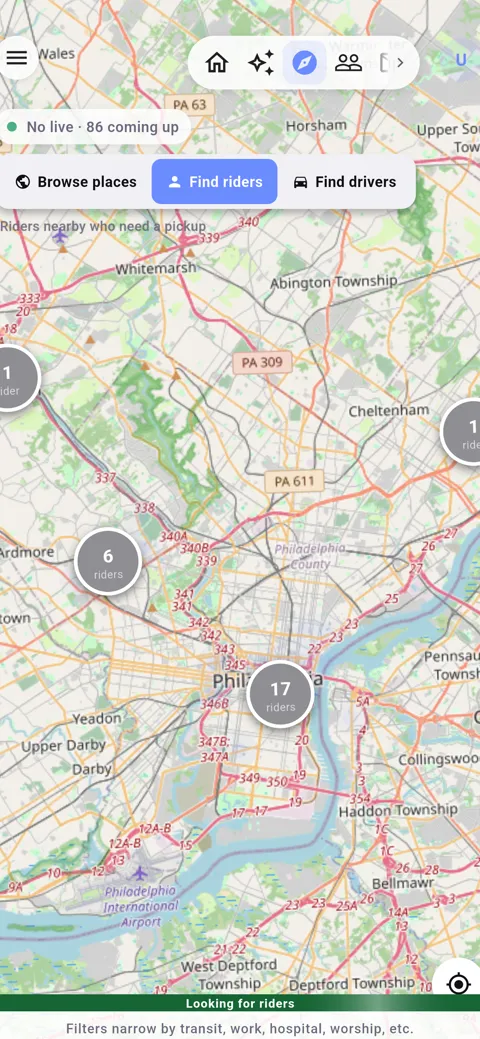
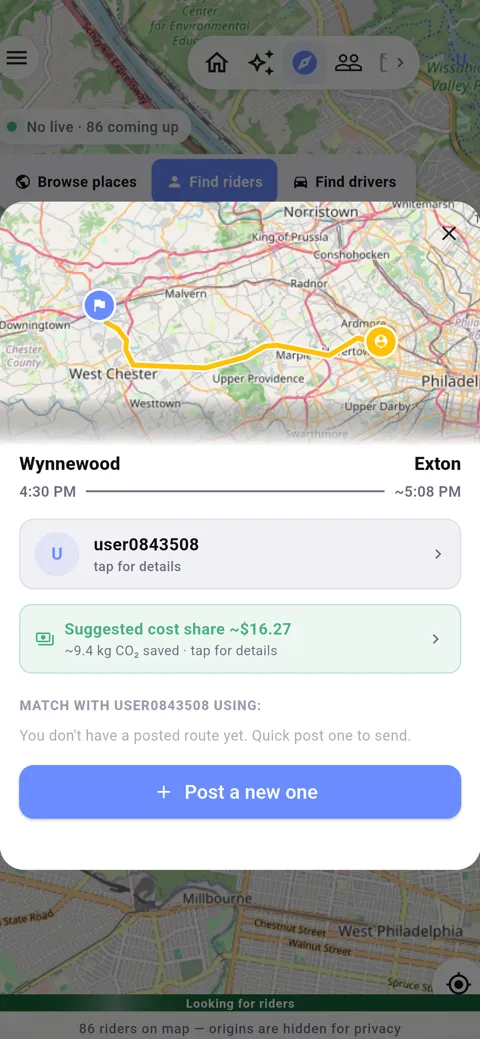
Sample screens. Names, places and times are examples.
Problem
Neighbors already share rides: commutes, hospital visits, games, concerts. Today that coordination lives in Facebook groups, email threads, and word of mouth, where the trust is real but finding someone headed your way at the right time is slow and manual.
Ride-hailing apps solve the matching but not the use case. They are priced for one-off trips, take a cut of every fare, and treat the rider and driver as strangers. Nothing in between offers lightweight matching for people who would happily split gas with a neighbor, without handing exact home addresses to strangers.
In the app
Approach
The problem breaks into four questions. Each one maps to a piece of the system.
-
Who is going my way?
Routes are stored as coordinates, not text. Matching checks that pickup and drop-off both fall within about 5 km and that schedules overlap. Place search returns nearest results first, through a cached geocoding function.
-
Can I trust this person?
Profiles reveal more as a relationship progresses, from public to requester to connected. Browsing shows fuzzed locations; exact pickup coordinates are released only after both sides confirm. Profile photos are reviewed before they go live.
-
How do we coordinate?
A request / accept flow with seat counting, in-app chat over Realtime, and push notifications for requests and new matches. Event pages give one-off trips (games, concerts) a shareable link.
-
Can one person run it?
No money flow to manage, one codebase for three platforms, one Supabase project for auth, data, storage, and functions, and scheduled jobs that expire old routes and caches without manual cleanup.
Architecture
Scroll sideways to see the full diagram.
Key decisions
-
Stay out of the money
over in-app ride payments
Taking payment for rides triggers rideshare (TNC) licensing in 30+ US states, plus chargebacks and app-store fees. The app suggests a fair cost share and the two people settle it themselves. No payments compliance, no commission to resent.
-
Enforce privacy in the database
over checks in the app
Browse queries return fuzzed coordinates, the routes table is readable only by its owner, and exact pickup points come from a single function that requires a confirmed booking. App code can be modified; database policies cannot.
-
One function per ride action
over direct table writes
Request, accept, cancel, and complete each run through a function that validates the state transition and seat counts. The rules live in one place instead of in every client, and pgTAP suites cover the booking flow and abuse cases.
-
Flutter for all three platforms
over native iOS and Android apps
One Dart codebase ships iOS, Android, and Web. For a solo product that is the difference between maintaining one app and three, and the web build means a shared link opens without an install.
Results & status
- Live on the iOS App Store and on the web at
app.carpool1.com. - Android in closed testing on Google Play, moving to production.
- Open alpha focused on the Philadelphia metro area.
- Tested at both layers: 600+ Flutter tests, plus pgTAP database suites covering the booking flow, abuse cases, and event visibility.
Stack
- Flutter / Dart
- Riverpod
- go_router
- flutter_map + OpenStreetMap
- Supabase
- Postgres + RLS
- pg_cron
- pgTAP
- Edge Functions (TypeScript)
- Firebase Cloud Messaging
- Photon geocoding
FAQ
Isn’t this architecture proprietary?
Not in any way that matters. The stack and the features are visible to anyone who opens the web app. The diagram is a summary, not a blueprint: the source code, the data, security specifics, and business plans are not published here. What makes a product like this hard to copy is people using it in one area and the judgment behind decisions like the ones above, not knowing which services it runs on.
Do drivers get paid through the app?
No. Carpool1 never handles ride payments. It suggests a fair cost share based on the route, and the rider and driver settle it between themselves. That keeps it a community board rather than a rideshare service, with none of the licensing that comes with one.
Why start in Philadelphia?
A carpool board is only useful when enough drivers and riders are in the same area. Focusing the alpha on one metro builds that density before expanding.